Lake County, California: Overview
Lake County is a predominantly rural region located in the west-central area of Northern California, north of San Francisco and northwest of Sacramento. Lake County is renowned for its natural beauty and outdoor recreational opportunities, making tourism a key part of the local economy. The region’s centerpiece, Clear Lake, is the largest natural freshwater lake entirely within the California state and is a popular destination for boating, fishing, and water sports, drawing visitors from across the state. Surrounded by picturesque mountains and vineyards, the area also boasts numerous hiking trails, scenic drives, and wineries, contributing to its appeal as a peaceful getaway. The county’s hot springs and state parks, such as Anderson Marsh and Clear Lake State Park, are significant attractions as well. However, recurrent wildfires have devastated local communities and negatively impacted tourism in recent years—leading to economic setbacks for local businesses. Enhancing the county’s resilience and ensuring sustainable tourism practices are critical for maintaining this vital sector of the local economy. Despite its natural beauty, the county faces numerous socio-economic and environmental challenges, making it a focal area for resilience-building efforts.

Credit: Lake County, CA
Natural Hazards and Climate Change Impacts
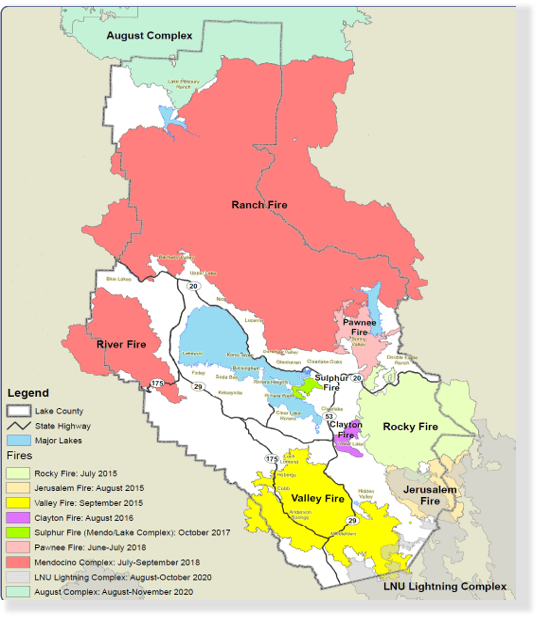
Lake County is highly susceptible to multiple natural hazards, including wildfires, floods, drought, extreme heat, and secondary hazards such as landslides and debris flows (Lake County Local Hazard Mitigation Plan, 2023). Over 60% of the county landmass has burned since 2015 due to a series of large-scale wildfires, making it one of the most fire-affected regions in the country. The combination of steep terrain and reduced vegetation also increases the risk of post-fire flooding and debris flows, especially during the rainy season. Climate change is intensifying the frequency and severity of natural hazards in Lake County—contributing to longer fire seasons, extreme heat, and more intense rainfall events. These changing conditions increase the risk of wildfire, erosion, and flooding—threatening both human safety and the county’s economic stability. The need for adaptive strategies and proactive planning is urgent to mitigate these escalating risks.
Population, Socioeconomics and Socio-Demographics
With a population of approximately 68,000, Lake County is characterized by small, dispersed communities. Many residents live in remote areas with limited access to essential services and infrastructure, making evacuation and disaster recovery particularly challenging. The county is also home to a large proportion of disadvantaged populations, not simply because it is rural, but due to factors including economic hardship, limited educational opportunity, and restricted access to healthcare, reliable public transportation, and emergency services. Lake County ranks among the lowest in California in terms of income and economic opportunity (National Institute on Minority Health and Health Disparities, 2024), with limited access to higher-paying jobs and educational resources. The employment rate is 48.8%, and only 16.8% of the population has attained a bachelor’s degree or higher. The area has a diverse demographic composition, with Hispanic (24.7%), Native American (5%), and other underrepresented groups making up a significant portion of the population (Census, 2024). The county is also home to a higher proportion of older adults compared to the state average, and about 17% of its residents are living below the poverty line. These factors, combined with persistent poverty levels, result in heightened vulnerabilities to natural disasters and economic shocks. According to the Climate & Economic Justice Screening Tool (CJEST), 65.4% of Lake County’s population is classified as disadvantaged, compared to the state average of 37.9%, highlighting the significant challenges faced by county residents.
Health Conditions
Lake County has consistently ranked among California’s lowest counties for health outcomes (County Health Rankings, 2024). Country residents experience significant health disparities, including high rates of chronic illnesses such as cancer, diabetes, cardiovascular disease, and respiratory conditions (National Center for Health Statistics, 2024). The limited availability of healthcare services exacerbates these challenges, creating barriers to effective health management and emergency response. Mental health issues and substance abuse are also prevalent concerns in the area. Nearly 18% of residents report serious psychological distress and the Lake County suicide rate is nearly 2.5 times the rate of completed suicides in all of California, with 87% of 18-24-year-olds having thought seriously about suicide (Lake County Community Health Needs Assessment, 2022). As such, residents experience multiple forms of vulnerability to the negative health impacts of cascading climate-related hazards. Specifically, 52% live in a high-risk wildfire area; 46% live with multiple chronic health conditions (e.g., diabetes, asthma, heart disease, cancer); 22% are living with disability; 33% live in rural areas of the county (Maizlish et al., 2017). Together, these findings illustrate that Lake County is disproportionately vulnerable to environmental hazards due to greater exposure to pollutants and other chemical stressors, pre-existing health inequities, and limited resources to cope with the cascading climate-related hazards the residents face.
Infrastructure
Lake County’s infrastructure is limited, and in many cases outdated, which makes disaster management and economic development challenging (Lake County). Lake County’s road network is sparse and isolated, with many rural areas relying on a limited number of key roads for access. There are only a few major highways, including State Routes 20, 29, and 175, which are often the only routes connecting remote communities to vital services, such as food distribution centers and healthcare facilities. Many of the smaller roads in the county are winding and narrow and pass through mountainous terrain, which makes them particularly vulnerable to closure from landslides and debris flows (Caltrans). The lack of alternative routes means that even minor disruptions can lead to significant isolation in certain areas, cutting off access to essential supplies and exacerbating food insecurity, especially in the event of natural hazards. Other critical infrastructure, such as hospitals, fire stations, and communication networks, are also sparse and, in some areas, vulnerable to natural hazards. For example, wildfires have damaged power lines, causing prolonged outages and disruptions to daily life and emergency services. Additionally, the county’s water supply and distribution systems are increasingly stressed by drought and changing precipitation patterns, further complicating the region’s resilience to climate change and natural disasters. As such, improving the resilience of Lake County’s infrastructure is essential to supporting its communities in the face of ongoing and future climate-related challenges (FEMA).
 Lake County Cascading Hazards